
WordPress or custom code? Choose the tool after the goal
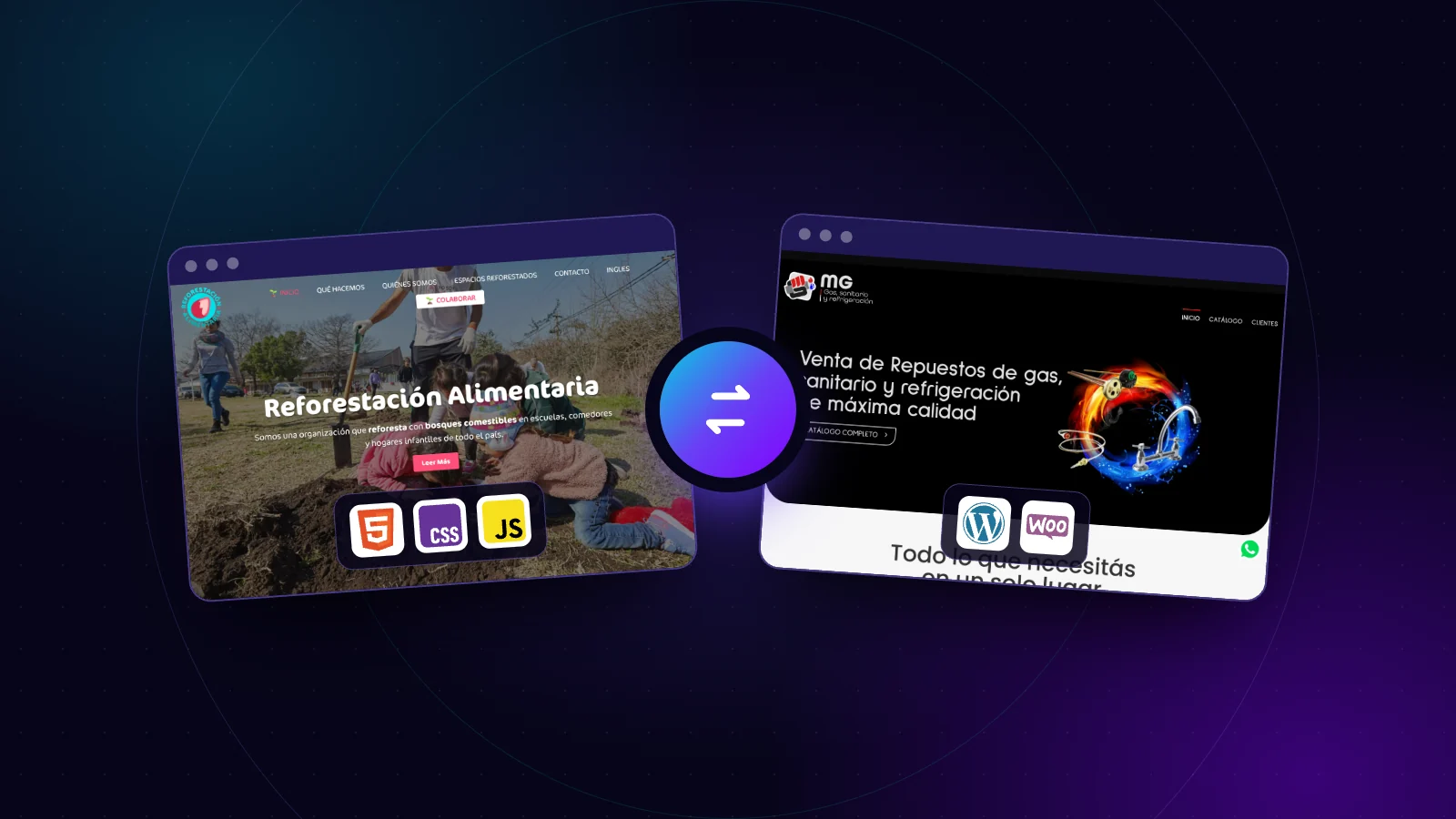
When someone asks me about a website, one of the first questions is usually: “Will you build it in WordPress?”. And the answer is: it depends. I work a lot with WordPress and WooCommerce, but I also develop with HTML, CSS, JavaScript and PHP. What matters isn't falling in love with a platform: it's choosing the tool that makes sense for what that website needs to do.
A website doesn't start in the admin panel
Before installing anything, I need to understand why the project exists. Does it need to receive enquiries? Show a portfolio? Sell products? Manage courses? Update prices every day? Does the team need to add content on their own? These questions completely change the technical solution.
If there's a store with hundreds of products and people who will manage the catalogue, WooCommerce can be a very useful base. If the project wants to tell the story of a cause with a specific visual experience, custom development may be a better fit. And often the best option is a combination: a CMS to manage content and custom code to solve a specific need.
Custom code doesn't mean making everything more complicated
For the Reforestación Alimentaria redesign I worked directly with HTML, CSS and JavaScript. The challenge wasn't setting up a store or adding a complex admin: it was reorganising a website that already existed, improving the navigation, looking after the visual identity and making the animations and buttons support the message.
On the other hand, in projects like MG Gas, the store needed more than a pretty face: categories, product codes, approved customers and processes to update prices. There, a WooCommerce base complemented with custom development made it possible to use proven features without forcing the business to work like a conventional retail store.
What gets evaluated besides the design?
I look at maintenance, autonomy, scalability and security. A website the client can't update when they need to can become a burden. A website full of plugins to solve every detail can also be hard to sustain. And custom development without documentation isn't a good decision either.
That's why I'm not interested in selling one platform as a universal solution. Sometimes the best answer is to simplify. Other times, to build a feature that doesn't exist yet. And other times, to say there's no need to rebuild the whole site.
Good judgement shows once the website is in use
The final question isn't “what is it built with?”, but “does it solve the problem, is it easy to understand and can they maintain it?”. Design, content, SEO, development and day-to-day operation have to work together. That's what I aim for whenever I take on a project.
If you have a website and you're not sure whether to redesign it, optimise it or change platforms, we can assess it based on what your business really needs.